AI Specifications
Integrating artificial intelligence into the drafting of specifications for cultural and heritage institutions
Defining the objectives
A heritage AI project relies first and foremost on a precise definition of needs, formulated in light of the capabilities of current technologies.It is necessary to identify production objectives and the framework for the final use of the data upstream of the project.
Needs and end users
- Internal use ?
- Published for larger audiences ?
Deliverable format
- Output granularity (page, paragraph, line, word, segmented image...)
- Export format (CSV, Excel, XML, JSON, custom CMS software import, API, integration into a custom visualization platform...)
Performance
- Evaluation method
- Target error rate
- Percentage of human validation
Data and security
Defining the nature of the documents allows for the selection of an appropriate processing method: for confidential data, complete control of the processing chain will be necessary, while open data can be sent to companies with large language models. Sovereignty and energy efficiency criteria may necessitate compromises on processing performance.
Corpus and volume
- Number of views
- Complexity of the layout (tables, press?)
- Period of the documents (paleography?)
Models under consideration
- Commercial (high-performing)
- Open-source (secure)
- Custom fine-tuning (frugal, secure)
Nature of the data
- Public domain
- Confidential data
- Sensitive data
Sovereignty and CSR
- Hosting France/Europe/World
- On-premise processing
- Social and environmental impact
Timeframe and budget: What to expect?
To plan for an AI project, you must consider the time required for data import and preparation, configuration, and validation. Your teams' expertise will be needed both before and after processing to ensure the results align with your objectives. We recommend allocating sufficient human resources to monitor the project.

Timeline
A document and iconography processing project lasts between 3 and 12 months.
1
Defining the scope
2
Collecting ground truth
3
Configuration
4
Production
5
Quality Control
6
Export or system integration
Budget
For a standard AI project, budgets are estimated to be between €6,000 and €20,000. The costs of projects carried out by TEKLIA vary according to the following criteria:
Project complexity
Heterogeneous data, unusual layouts, older scripts…
Choice of infrastructure
Processing on CPU (slower but more energy-efficient) or GPU (faster but more expensive)
Cost of AI models
Commercial APIs, open source models, or custom models trained by our team
Data volume
Economies of scale apply when document types are homogeneous
Post-processing time
Depending on the quality control methodology chosen
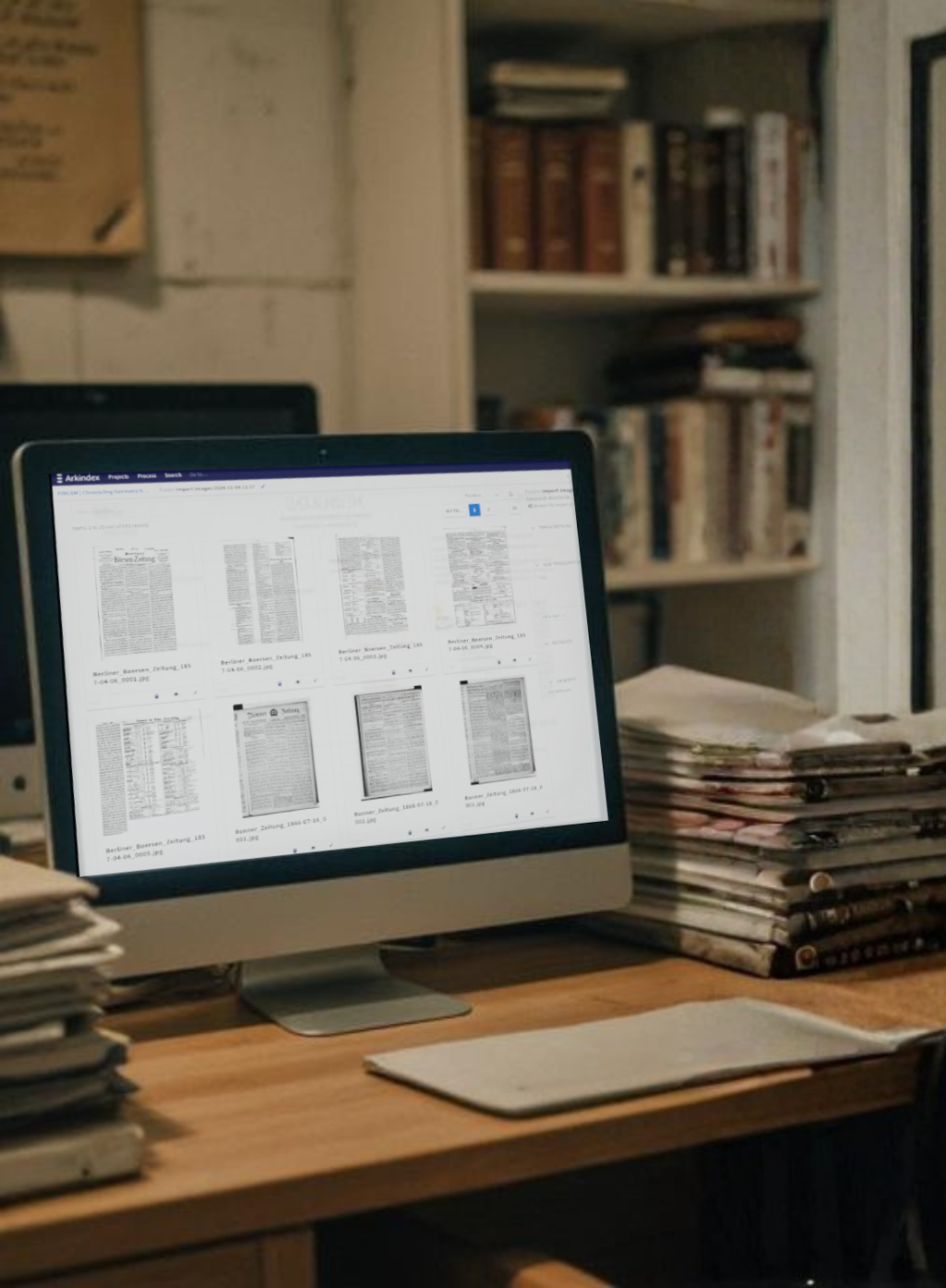

Download our AI CHEKLIST
This summary sheet allows you to specify your project in a set of specifications through a four-step reflection: temporality, objectives, data and security, and types of processing.
Need advice?
Our team can help you define and structure your AI project from the outset, guiding you towards the most suitable methodology.